
In this post, we'll help you understand how ecommerce payment processing actually works, what all the components do, and how to set it up correctly.
What is Ecommerce Payment Processing?
Ecommerce payment processing is a financial and technical system that authorises, clears, and settles funds between the customer's issuing bank and the merchant's acquiring bank. It involves several parties: the customer, the merchant, a payment gateway, an acquiring bank, a card network (Visa or Mastercard), and finally an issuing bank. All of these parties communicate in a coordinated sequence to authorise, clear, and settle funds.
The process is designed to be quick. It is also secure and invisible to the end user. If everything works well, customers don’t notice, but when it doesn’t, you lose the sale.
How Ecommerce Payment Processing Works
Customer Checkout
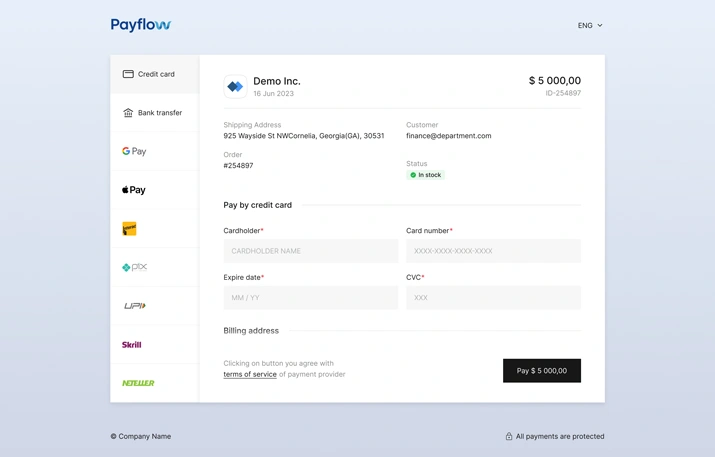
The process starts once a paying customer selects the payment method. If they choose their credit card, they enter their card details, such as the card number, expiration date, and CVV. Or they may select another digital payment available, such as Apple Pay or Google Pay.
Payment information is collected from a form embedded on the checkout page. So, the key is a well-built checkout and payment form, as a poorly designed page is one of the top causes of cart abandonment.
Encryption via a Payment Gateway
Before any data is sent anywhere, it must be encrypted. Data is transmitted over TLS. Tokenization reduces exposure by ensuring your servers don't handle raw card numbers. PCI DSS compliance requirements begin here, and non-compliance can result in stiff fines and loss of card acceptance rights.
The payment gateway handles this part. It encrypts the customer's sensitive payment data with TLS and tokenizes card details to prevent raw card numbers from being exposed during transit. That is the first line of defence against data interception. PCI DSS applies to the entire environment where cardholder data is stored/processed/transmitted. If you have hosted fields/redirect, the merchant's PCI zone may be smaller; if you have direct collection, it may be larger.
Verification by a Processor and Issuing Bank
The encrypted transaction data gets moved (routed) to the acquiring bank (your bank), which sends the authorisation request via the relevant card network (Visa, Mastercard, etc.) to the issuing bank (the customer's bank). The issuing bank then decides whether the card is valid (not stolen) and if the buyer has sufficient funds or credit available for the purchase.
Authorisation
The issuing bank sends its authorisation response: approved, declined, or referred. The response is sent back along the same chain, from card network to acquirer and gateway. It only takes seconds. If approved, funds are ring-fenced in the customer’s account but aren’t transferred. Before that happens, risk and fraud controls are applied, such as 3-D Secure (3DS) authentication, velocity checks, and scoring.
Final Settlement
Authorisation does not mean payment. Settlement is a payment. After the transaction is authorised, it enters a clearing and settlement cycle that usually lasts 1 to 3 business days. The card network streamlines the interchange between the issuing and acquiring banks. After this, the merchant receives the funds in their account, minus any fees applied, such as interchange, scheme, and processor margins.
The Key Components in Ecommerce Payment Processing

Checkout and Payment Data Collection
The point where the card or wallet details are collected. The payment must be securely processed via a hosted payment page or an embedded form that uses tokenization, guaranteeing that raw card data never touches the merchant server. The checkout UX directly affects conversion rates.
Payment Gateway
The gateway encrypts the transaction information and then routes it to the acquirer, which serves as the secure communication layer between your platform and the broader payment network. Good gateways also provide you with reports, retry logic, and routing controls. Every gateway is different, though, with varying speeds of throughput, uptime, and latency.
Acquirer and Card Networks
Your acquiring bank has all of your merchant account details and processes transactions on your behalf. The card networks set the rules for how authorisation requests are routed, which fees apply, and which special compliance requirements must be met. In most cases, merchants don’t interact with the card networks, as this part is typically managed by the acquirer.
Issuer Authorisation
The issuing bank decides if a transaction gets approved. Reasons for a transaction being declined include insufficient funds, suspected fraud, exceeded limits, and geographic restrictions. So, the key is to be familiar with the decline patterns as a high rate of decline can often point to routing problems, fraud scoring issues, or card type mismatches that can be corrected.
Fraud and Risk Controls
Fraud and risk controls are in place at multiple points in the transaction flow. 3DS authentication verifies the cardholder's identity as an additional step before authorisation. Fraud scoring models assess transaction risk using behavioral signals, device data, and historical patterns.
Additionally, Anti-Money Laundering (AML) monitoring may be performed by the PSP/acquirer, and merchants/customers are assessed during onboarding through Know Your Customer/Know Your Business (KYC/KYB) processes. All this aims at blocking fraudulent transactions without increasing friction for legitimate customers, a very fine balance.
Clearing and Settlement
Once transactions have been authorised and batched, the card network provides clearing/settlement between the issuer and the acquirer, along with the corresponding settlements/netting. The merchant then receives funds as payout from the PSP/acquirer according to their payout schedule.
For merchants processing high volumes, keeping settlement reconciliations clean and on schedule is one of the more operationally demanding parts of payment management - and a common source of revenue leakage if not handled correctly.
How to Set Up Payment Processing for Ecommerce
Develop Your Strategy
Before you start evaluating vendors, define your requirements. What are your markets? Are they international? What payment methods will your customers expect? Are they cards, wallets, or local payment methods? What is the currency you will use? What is the expected transaction volume, and will it grow? The answers to these questions determine what type of infrastructure you need and which partners can support it.
Review Internal Technical Capabilities
Your integration approach comes down to what technical resources you have. A direct API integration gives you better control over the payment experience, but it requires ongoing maintenance and may require development effort. A hosted option can reduce development time but limits customisation, so honestly assess your team's capacity before committing to an approach.
Partner With a Payment Provider
Find a payment provider that covers all your required geographies, accepts your preferred payment methods, and provides the technical infrastructure to match your volume. Check out uptime guarantees, fraud tooling, reporting capabilities, and support responsiveness, not just their pricing bracket. A good provider that can route transactions intelligently across multiple acquirers will usually deliver higher approval rates than a single-acquirer setup.
Testing and Trial
Before you go live, plan a testing phase. Perform end-to-end testing across all payment methods, currencies, and edge cases. Check for declined transactions, partial refunds, 3DS flows, and chargebacks, and test in an environment that mirrors production as closely as possible. Never skip this stage, because any issues that arise later will be much more expensive to fix than during testing. Testing and trials will help you identify any problems before you go live.
Ecommerce Payment Processing with Payneteasy
Payneteasy is a payment infrastructure technology built for merchants and PSPs operating at scale. Our platform offers a comprehensive solution by covering everything from a
PCI DSS Level 1-certified payment gateway with advanced routing and cascading to an anti-fraud security system, all fully integrated with dispute management tools and reconciliation reporting.
The Payneteasy Orchestration Platform (POP) consolidates everything that merchants need to manage multiple payment providers into a single interface. It helps you reduce operational overhead, increase acceptance rates, and gain real-time control over your payment flow.
Payneteasy has more than 1,000 integrations and almost 20 years of experience processing for PSPs, banks, and
large-scale ecommerce businesses. If you're evaluating payment infrastructure or looking to improve approval rates and settlement efficiency, get in touch to see how Payneteasy fits your setup!
Key Takeaways
- Ecommerce payment processing routes online payments through a chain of parties - gateway, acquirer, card network, and issuer - in a matter of seconds.
- Authorisation and settlement are completely separate events; approved funds will usually take one to three business days to transfer into your merchant account.
- Every part of the chain, the checkout, encryption, fraud controls, and routing, all directly affect your approval rates and revenue.
- Intelligent routing across multiple acquirers consistently outperforms single-acquirer systems in approval rates.
- The right payment provider partner is more than just the cost. Evaluate features like uptime, fraud tooling, geographic coverage, and integration flexibility.
Contact author