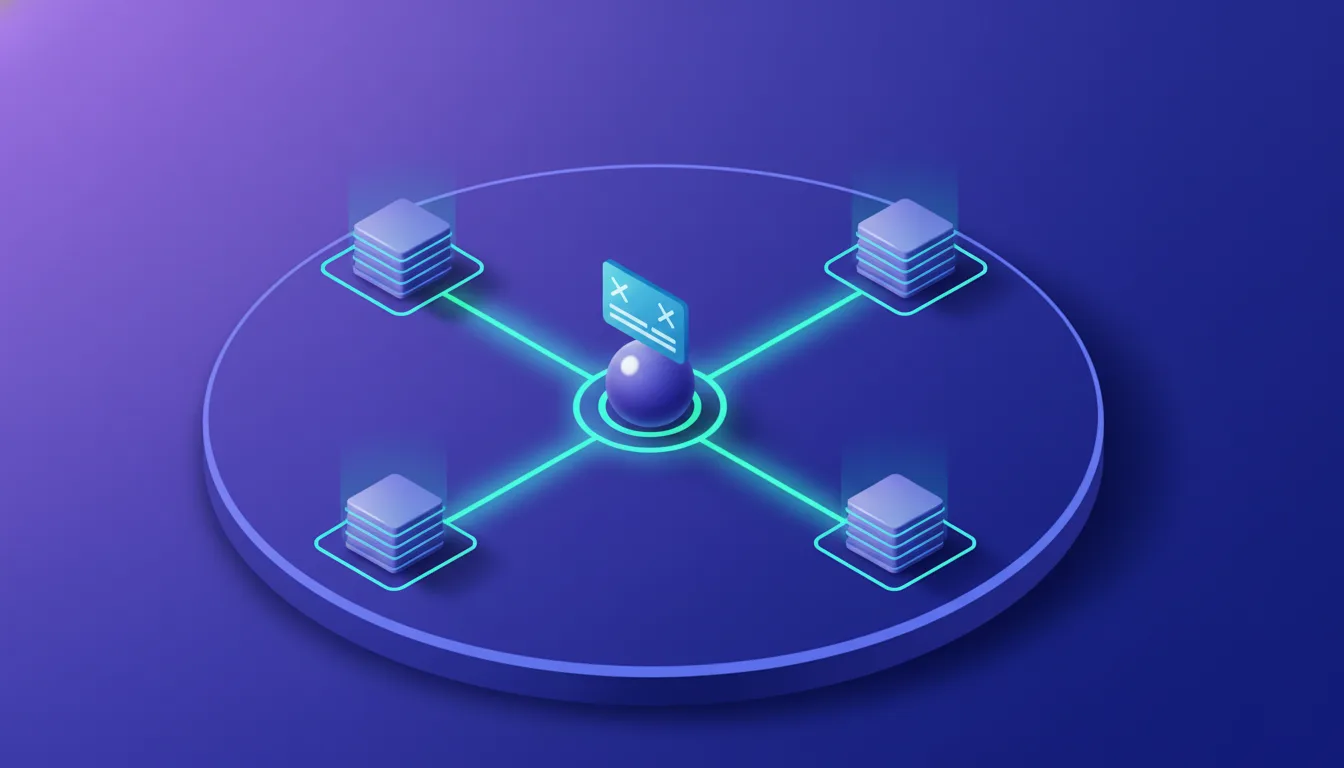
This article walks through what payment cascading actually is, how a cascade decision tree is built, what inputs smart routing uses, where the realistic auth-rate uplift comes from, the anti-patterns that turn cascading into a chargeback factory, and the KPIs that tell you whether the engine is working. Payneteasy is referenced here as a technology orchestration platform — not as a regulated financial institution or money-services business.
Why 12 to 20 Percent of Good Transactions Decline
The friction-free authorisation is the exception, not the rule. Issuers run their own risk models on every authorisation, and those models reject transactions for reasons that range from genuine fraud signals to noise: a new device, an unusual amount-and-MCC combination, a velocity bucket the cardholder happens to land in, a 3-D Secure step-up that times out on the buyer's slow connection. Some declines are hard — closed card, insufficient funds, do-not-honour with a real reason. Many more are soft — the same card, retried five minutes later through a different acquirer with the same data, simply approves.
The distribution matters operationally. In a high-volume merchant book, the difference between an 82 percent and a 92 percent approval rate is not a small optimisation; it is the difference between a margin-positive year and a margin-negative one. Every recoverable decline that quietly disappears is revenue that the merchant earned the right to capture and did not.
What Payment Cascading Actually Is
Payment cascading is the mechanism by which a failed authorisation is retried across an alternative acquirer or processor, under explicit decision rules, with deterministic state. It is not the same as a naive client-side retry. A cardholder hitting "Pay" twice on a checkout page after a decline is not cascading; it is a duplicate attempt, often with the same routing, and typically produces the same decline plus a degraded risk signal on the issuer side. A neighbouring overview of cascading payments as a concept covers the merchant-facing view; the focus here is the engine.
Real cascading sits behind the merchant. The first authorisation attempt is sent to the acquirer chosen by the smart routing layer. If that attempt fails for a recoverable reason — and only for a recoverable reason — the orchestration layer reroutes the same transaction to a second acquirer within a defined retry window, with the original transaction ID preserved for reconciliation and the original 3-D Secure result respected so liability is not lost.
Critically, cascading is selective. It is triggered by specific decline categories — issuer not available, do-not-honour with no fraud indicator, generic decline, soft 3-D Secure failure — and explicitly suppressed for others. Closed accounts, lost-or-stolen flags, fraud-suspected codes, hard-no responses and any decline that signals a risk decision must not retry. Retrying a fraud-flagged transaction across three acquirers is how a merchant earns a chargeback ratio that triggers MasterCard's Excessive Chargeback Program.
Cascade Decision Tree: Decline Code, Next Acquirer, Retry Window
A workable cascade engine is built around three axes: the decline reason on the failed attempt, the candidate acquirer to retry through, and the retry window in which the retry is legally and operationally sensible.
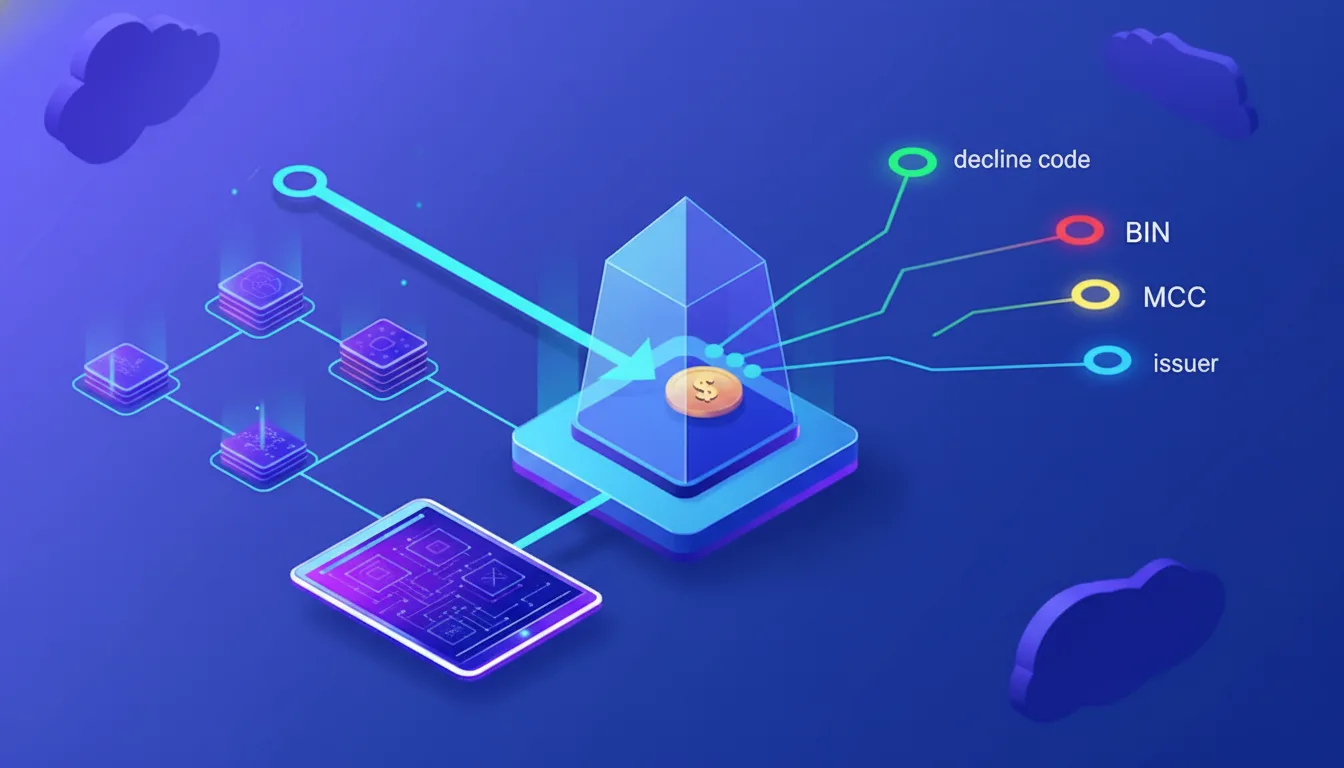
The decline reason is the gatekeeper. Each ISO 8583 response code (and its scheme-specific equivalents) is classified into one of three buckets: retry-allowed, retry-conditional or retry-blocked. Retry-allowed covers issuer-side noise — temporarily unavailable, generic decline, do-not-honour without risk flag. Retry-conditional covers cases where the next attempt must change something: a 3-D Secure step-up may be replaced by a frictionless attempt on a different MID, or an MCC-restricted decline may route to an acquirer with the right MCC permission. Retry-blocked is non-negotiable: stolen card, expired card, suspected fraud, insufficient funds beyond a small threshold. The engine evaluates this classification before it touches anything else.
The candidate acquirer is chosen from a routing table indexed by BIN range, currency, MCC, transaction amount band, the cardholder's country and the historical approval rate for that combination on each acquirer. A cascade does not simply send to the next acquirer in a list; it sends to the acquirer most likely to approve this specific transaction given everything known about it. The first attempt and the cascade attempt usually go to different acquirer families precisely because the issuer's reaction to the second processor will be cleaner.
The retry window is the third axis and the easiest to get wrong. Schemes and issuers tolerate retries within a tight window — typically milliseconds to a few seconds — when the original authorisation has failed with a soft code. Beyond that, the retry stops being a single buyer intent and becomes a separate transaction that may need a fresh SCA. Cascading inside a one-to-two-second window from the original failure is operationally clean; cascading minutes later, without the buyer's awareness, is not, and most regulated regions will not treat it as the same buyer-intent transaction.
Smart Routing Inputs: BIN, MCC, Amount, Currency, Issuer History, 3DS Flag
Routing is the first half of the equation, and the inputs that drive it are concrete. Six are load-bearing in any real engine.
BIN — the issuing-bank identifier embedded in the card number — is the strongest single signal. Approval rates vary by 10 to 25 percentage points across acquirers for the same BIN because of issuer-acquirer relationships, scheme membership and historical clearing patterns. A routing table indexed by BIN range and acquirer is the minimum competent setup.
MCC — the merchant category code — interacts with BIN because issuers have category-level risk preferences. The same BIN may approve cheerfully on a low-risk MCC and decline aggressively on a regulated one. Smart routing chooses an acquirer that is both BIN-compatible and MCC-permissioned.
Transaction amount band matters because issuer risk models step at thresholds — small purchases are nearly always approved, large ones are scrutinised, mid-range ones depend on the BIN and the MCC. Routing rules use coarse bands (for example, under €30, €30 to €300, €300 to €3,000, above €3,000) rather than continuous amounts.
Currency and cardholder country together drive whether the transaction is treated as domestic, intra-region or cross-border. Cross-border interchange is more expensive and approval rates are lower; routing through an acquirer with local presence on the issuing side can lift approval rates noticeably and reduce cost.
Issuer history is the learned input: the rolling approval rate per BIN per acquirer over the last 7, 30 and 90 days. This is the data layer that makes routing adaptive rather than static. An acquirer that approved 94 percent of a given BIN last quarter and 71 percent this week has changed, and the routing weights must follow.
The 3-D Secure flag is the final input and the one most often mishandled. A transaction that already carries a successful authentication carries the liability shift with it; the cascade attempt must preserve that, not re-authenticate. Re-authentication adds friction the buyer never asked for and may break the SCA chain entirely, dropping the liability shift on the recovered transaction.
Auth-Rate Uplift Math: Where 8–15 Percent Recovery Comes From
The 8 to 15 percent recovery range is not a marketing number; it falls out of a specific arithmetic. Assume a merchant runs at an 85 percent approval rate before cascade is enabled. Of the remaining 15 percent declined, the retry-allowed and retry-conditional buckets typically cover 55 to 70 percent of the volume — the rest is hard declines that must not retry. Of the retry-eligible volume, real-world cascade attempts approve in the 25 to 45 percent range depending on the acquirer mix and the quality of the routing logic.

Combining those: 15 percent declined × 60 percent retry-eligible × 35 percent retry success ≈ 3.15 percent of total transaction volume recovered as additional approvals. Expressed against the original declined volume (15 percent), that is roughly 21 percent of declines recovered — or, depending on how the merchant counts, 8 to 15 percent of declined transaction value pulled back into approved revenue. The exact figure depends on vertical mix, BIN diversity, acquirer count and how aggressively the cascade engine has been tuned to reject retry-blocked codes.
The number is bounded above by hard-decline volume and bounded below by routing quality. A poorly-tuned engine that retries everything will not recover more; it will recover the same plus a chargeback tail.
Anti-Patterns: Blind Retry, Soft-Decline Misuse, Breaking the SCA Chain
The most common cascade failure mode is treating every decline as recoverable. Blind retry — every failed transaction retried across two or three acquirers regardless of decline code — produces a short-term lift in approvals and a long-term lift in chargeback ratio that drags the merchant into scheme monitoring programs. The fix is the decline-code classifier described above; without it, cascading is harmful.
The second anti-pattern is using soft-decline codes as a routing signal when they are not. Some issuers return generic decline codes that conceal fraud signals; the cardholder did not lose their card, but the issuer's model flagged the transaction. Retrying through another acquirer succeeds on authorisation and produces a fraudulent chargeback weeks later. Sophisticated cascade engines suppress retries when the BIN's recent decline-to-fraud conversion ratio is elevated, even if the response code itself looks retry-eligible.
The third anti-pattern is breaking the SCA chain. Under PSD2 in the EU and UK and equivalent rules elsewhere, a transaction that already completed strong customer authentication carries that proof forward. A cascade implementation that re-runs 3-D Secure on the retry attempt introduces friction, drops conversion further and may lose the liability shift if the second authentication is non-frictionless or fails. The cascade must reuse the original authentication evidence; if the acquirer cannot accept it, that acquirer is not a valid cascade target for this transaction.
Build vs Buy: In-House Orchestration or PSP-Native Cascade
The build-versus-buy question on cascade and routing has three concrete dimensions. The first is integration breadth: building it in-house means integrating with every acquirer the merchant uses directly, maintaining each integration as scheme rules evolve, and operating the routing table as a piece of production software. For a merchant with two acquirers, this is tractable. For a merchant with five or more, the maintenance cost climbs steeply.
The second dimension is data. Smart routing improves with volume because the per-BIN approval-rate table needs sufficient observations per acquirer per BIN to be statistically meaningful. A single-merchant in-house build sees only that merchant's transactions; an orchestration platform that runs cascading for many merchants accumulates a much denser observation set, with the caveat that the data must remain merchant-segmented for compliance.
The third dimension is operational responsibility. When the cascade engine misfires, the merchant's engineering team owns the incident in an in-house build. In a PSP-native or orchestration-platform model, the engine's behaviour is the platform's responsibility, observable through dashboards and tunable through configuration without code changes. For most merchants, the orchestration model trades a small per-transaction cost for a meaningful reduction in operational surface.
KPIs: What to Measure, and How
A cascade engine without measurement is a black box. Four KPIs together cover the operational picture.
Approval rate by BIN per acquirer is the primary observability metric. It is what the routing weights are conditioned on, and watching it shift week-over-week reveals issuer behaviour changes before they become a revenue problem.
Retry success ratio — the percentage of cascade attempts that approve — is the engine's own self-report. A healthy ratio sits in the 25 to 45 percent range; a number above 60 percent usually means the engine is being too conservative on retry-eligibility (and is leaving recoveries on the table); a number below 15 percent means the routing logic is choosing badly or the merchant has a structural hard-decline problem that cascading cannot fix.
Cost per recovery, expressed as the additional acquirer and scheme fees incurred on cascade attempts divided by the additional approved value, sets the economic floor. Cascade recoveries are only profitable while this number stays well below the merchant's blended margin on those transactions.
Chargeback ratio on cascade-recovered transactions, monitored separately from base chargebacks, is the safety check. If the cascade engine is recovering revenue at the cost of a structurally higher chargeback rate, the decline-code classifier is wrong and must be retuned.
Conclusion: Cascading as a Competitive Layer, Not a Switch
Smart transaction routing and cascade logic are not a feature merchants enable and forget. They are a continuously-tuned layer between the merchant's checkout and the acquiring landscape, conditioned on data the merchant alone usually does not have at sufficient density. Done well, they recover 8 to 15 percent of declined volume cleanly, without chargeback drift and without breaking SCA. Done badly, they produce headline approval-rate lifts that unwind two months later under scheme monitoring. A companion piece frames the same engine from the revenue side: how payment cascade routing recovers declined card sales.
Payneteasy works with acquirers, PSPs and merchants who treat routing and cascading as core infrastructure rather than as an add-on — orchestrating multi-acquirer flows, classifying declines, preserving authentication evidence across retries and exposing the KPIs that make the engine accountable. Contact Sales to discuss how a routing and cascade layer fits behind an existing payment stack.
Contact author
PSP
Orchestrate payments across multiple providers, optimise routing, and maximise approval rates with a single integration.