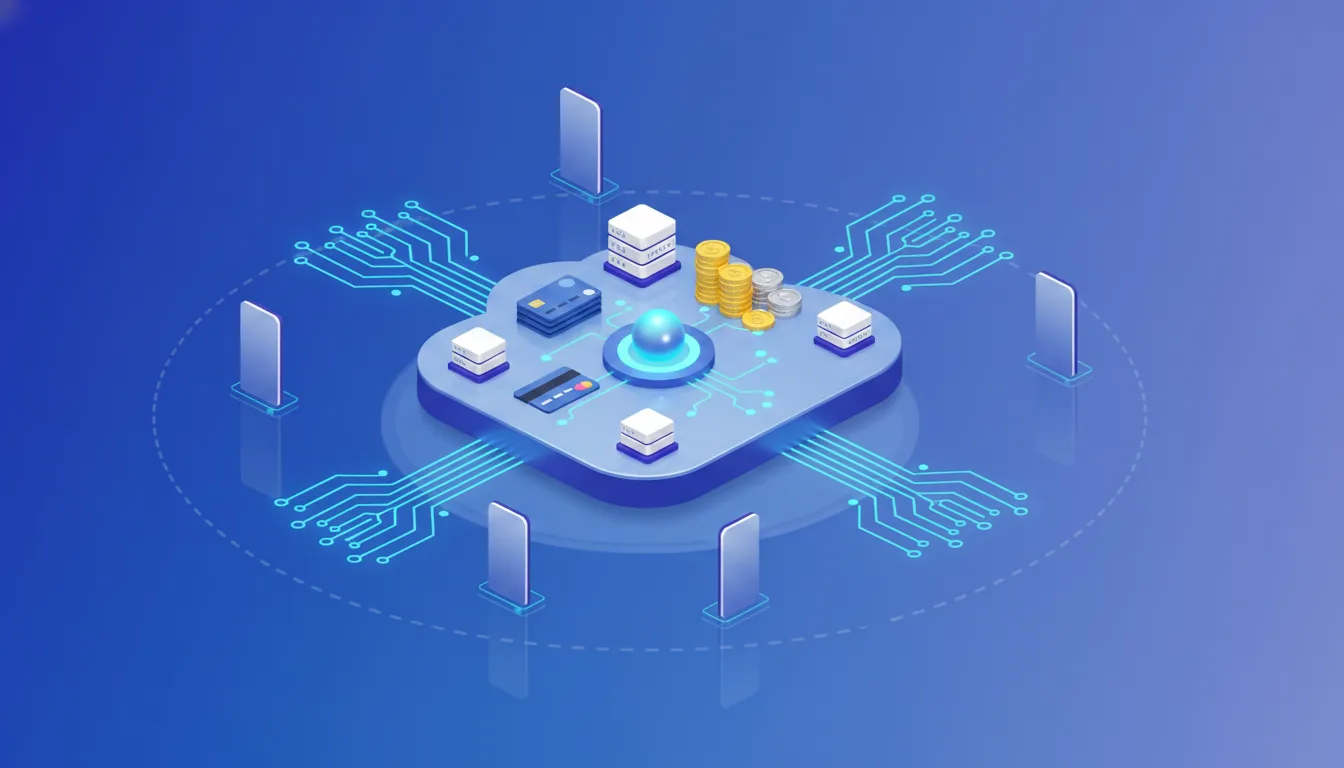
As software becomes easier to replicate, vertical platforms increasingly look for stickier layers to defend. One of the most durable is money movement. Embedded payments — taking, routing, splitting, reconciling and paying out funds inside the platform — turn a SaaS tool into operational infrastructure that customers cannot easily replace without rebuilding parts of their business.
This article examines why that shift is accelerating, what embedded payments require under the hood, and why payment orchestration sits at the centre of a robust implementation.
AI Is Changing How SaaS Platforms Compete
For the past decade, the moat of a vertical SaaS platform was domain depth: an industry-specific data model, the right vocabulary and integrations a generalist tool would rarely build. AI narrows that advantage. A clinic-management workflow, a logistics dispatch board or a freelance-marketplace billing screen can be sketched, drafted and outlined far more quickly than before.
In practice, feature parity alone is becoming harder to defend. Functionality that once took a release cycle to build can often be matched in a shorter window, and buyers increasingly evaluate platforms on the outcomes they enable rather than on feature lists.
Platforms that hold their ground share a pattern. They move from selling features towards supporting outcomes — accepted payments, paid suppliers, reconciled books, improved fraud visibility. Those outcomes depend on infrastructure that customers cannot trivially replace.
Why Software Alone Is No Longer Enough
There is a structural reason vertical SaaS platforms are pushed beyond pure software. A tool that only describes operations sits next to the business; a platform that runs operations sits inside it. The deeper a platform sits, the more disruptive it is to leave.
Consider a typical vertical SaaS journey. Stage one: scheduling, CRM, invoicing — useful but switchable. Stage two: workflow automation and integrations with banks or providers — sticky, but each integration is brittle and customer-owned. Stage three: the platform itself handles money — taking the payment, deciding how to route it, managing settlement and payouts to the right party at the right time. By stage three, the platform is no longer a tool. It is part of the operational fabric.
This is why many vertical platforms — in marketplaces, healthcare, hospitality, logistics and education — are building embedded payments alongside their core product. Owning the money flow is what shifts a SaaS vendor toward infrastructure customers depend on every day.
Embedded Payments as a Strategic Layer
Embedded payments mean that paying, getting paid, splitting funds and reconciling them happen natively inside the platform — without redirects to a third-party page, separate accounting tools or a customer's bank portal. The platform is where revenue lands, where it is routed and where it is reported.
Done well, embedded payments are more than an integration. They become a strategic layer with four reinforcing effects:
Stronger customer retention
Once a business runs accepted-payment, payout, refund and dispute flows inside a platform, switching costs rise sharply. A migration is no longer a database export — it touches payment relationships, settlement cycles, KYC records and stored payment credentials.
New monetisation surfaces
Embedded payments open revenue beyond subscription fees: transaction-related fees, FX margins, financing options, instant-payout features and risk-control add-ons. These streams scale with customer transaction volumes, aligning incentives in a way that flat SaaS pricing rarely does.
Better user experience
Checkout, payouts, refunds and dispute handling presented inside the same product are typically faster and clearer for end users. Removing an external payment page can also reduce drop-off in checkout flows.
Operational data depth
Owning the payment flow means owning the data behind it. Approval-rate analytics, decline-code patterns, fraud signals and settlement timing become part of the platform's intelligence and can inform smarter routing and risk decisions over time.
Why Payment Orchestration Matters
Connecting a single processor and calling it embedded payments is a common shortcut. It can appear to work — until traffic grows, geographies expand, approval rates fluctuate or a provider has an outage. At that point, a platform with one acquirer carries concentrated exposure across revenue, customer trust, support load and contractual flexibility.
This is where payment orchestration becomes the foundation of the embedded-payments layer rather than an optional upgrade. Orchestration treats payment providers as interchangeable rails and selects the appropriate one for each transaction based on rules, data and observed performance.
Smart routing
Smart routing selects an acquirer or method per transaction based on factors such as issuer country, BIN, currency, amount, customer history or recent approval performance. The same purchase from two customers may take different paths, each chosen to support a higher likelihood of approval.
Cascading
When a transaction fails for a recoverable reason, cascading retries it across alternative providers within milliseconds. For a vertical SaaS platform, this can be the difference between a completed checkout and a support ticket.
Risk and fraud controls
Embedded payments increase a platform's role in monitoring fraud exposure that previously sat with the merchant or processor. Built-in risk management — velocity limits, device fingerprinting, 3-D Secure orchestration and chargeback rules — should be treated as first-class parts of the system rather than plug-ins.
Unified reporting and reconciliation
If multiple providers move money on behalf of one platform, reconciliation cannot live in separate dashboards. Orchestration consolidates transactions, fees, settlements, refunds and disputes into a single, queryable view — the basis a finance team needs to close the books reliably.
Payouts
Marketplaces, gig platforms and B2B SaaS products with split flows often need to pay parties other than themselves. Orchestrated payouts can handle balance management, payout scheduling, multi-currency flows and compliance workflows without requiring a platform to staff a full treasury function.
What This Means for Vertical SaaS Platforms
A vertical platform that owns the software, the data, the risk logic and the money flow is structurally harder to replace. The replacement cost is no longer measured in seats migrated — it spans provider re-contracting, KYC re-onboarding, customer payment-credential continuity and finance-reporting rebuilds. The longer the platform operates this way, the larger that cost becomes.
From a product perspective, this changes the shape of the roadmap. A SaaS team that historically added forms and dashboards now needs to consider per-customer payment logic, settlement timing, dispute handling, payout governance and audit trails. These are not adjacent features — they become part of the core surface customers evaluate.
Importantly, none of this requires the platform itself to become a regulated financial institution. A well-designed embedded-payments layer, built on top of a payment orchestration platform with the necessary provider integrations and risk and compliance workflows, lets a SaaS company offer a fintech-style user experience while leaving regulated activity with the appropriate partners.
Agentic Commerce and the Next Stage of Payments
The reason this matters now, rather than in a few years, is that the next wave of commerce will not be driven only by humans clicking checkout buttons. AI agents, headless storefronts and automated procurement tools are increasingly initiating transactions on behalf of users and businesses. They compare offers, swap providers, retry failures, split orders across vendors and trigger payouts in the background.
Agentic flows raise the bar for payment infrastructure in three ways. First, they expose weak links — a single brittle provider becomes a structural ceiling on success rate. Second, they tend to generate higher volumes of small, similar transactions, which make smart routing and cascading materially more impactful. Third, they push reconciliation and dispute handling to be machine-readable and closer to real time, because fewer humans are available to resolve stuck batches.
A SaaS platform already running on orchestrated embedded payments is positioned for this shift. Adding agentic checkout, automated supplier payouts or AI-driven dunning becomes largely a configuration exercise. A platform built on a single processor will more often need to rework its payment stack to participate.
Software, Payments and Infrastructure
The future of vertical SaaS is software plus the payment infrastructure that turns the software into the system where the business actually runs.
AI will continue to compress the defensibility of pure feature work. The platforms that compound their advantage combine a clear vertical workflow with a payment layer they can configure, monitor and optimise — routing, cascading, risk, reporting, reconciliation and payouts as native parts of the product, supported by an orchestration platform underneath.
That combination is what makes a SaaS product hard to leave, and it prepares the product for a decade of commerce in which money increasingly moves under software control. Payneteasy works with vertical SaaS platforms making this transition — integrating orchestrated embedded payments into their product without forcing a rebuild.
Contact author
PSP
Orchestrate payments across multiple providers, optimise routing, and maximise approval rates with a single integration.