 By Boaz Gam, CEO, Payneteasy
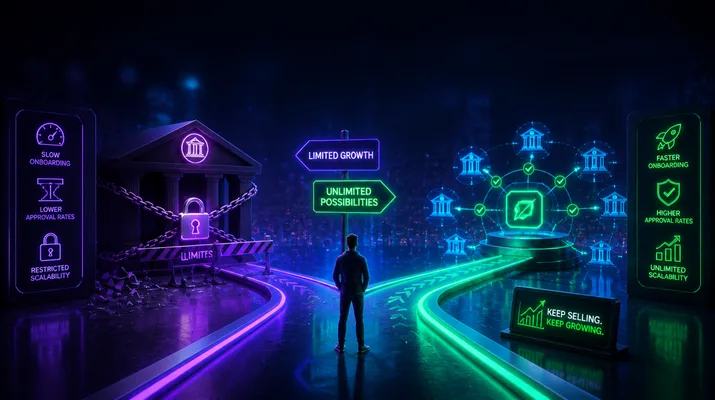
Your payment provider can quietly cap your growth. Most owners only notice when approvals fall or expansion stalls. So choosing a payment partner is not “implementing checkout” — it is one of the biggest strategic decisions your business makes. After 20 years in payments, the pattern is clear: the partner you pick decides how much you can grow, how often you lose sales you already won, and what happens the morning your one bank has a bad day.
This is the plain-English version of what to look for — and why it matters to your revenue, not just to your tech team.
What this guide covers
- The mistake that quietly caps you. Picking whoever gets you live fastest and staying on their single bank works — until a rule change, a fee hike, or a dip in approvals lands squarely on you with no second route.
- Independence: many banks, not one. A provider that owns its own bank has a reason to keep your traffic there. An independent partner sends every payment to whichever route actually clears it.
- Resilience: a bank's bad day shouldn’t be yours. Payment orchestration routes around outages, rule changes, and slow acquirers automatically, so one bank’s problem doesn’t stop your sales.
- Longevity: proven, not just launched. Payneteasy has spent about two decades routing across banks and recovering failed payments for demanding merchants.
- Readiness for generative AI (GenAI). A partner that opens your payment data through a safe, read-only connection means AI chatbots and AI agents — think ChatGPT, Claude, or Gemini — can already answer the questions you used to check a dashboard for.
- Five questions before you sign. Bank count, ownership, outage handling, data access, and track record — the answers make the right partner obvious.
- Where Payneteasy fits. An independent orchestration platform built for businesses that intend to keep growing, not just go live once.
The mistake that quietly caps your growth
The easy path is to pick whoever gets you live fastest, accept their single bank, and move on.
It works — until it doesn’t:
 That bank tightens risk rules on your category.
 Fees creep up on the cards your customers use.
 Approval rates sag in a new geography you care about.
If all your volume runs through one acquirer, every change lands squarely on you:
 You have no second route when a rule, a BIN range or a region is hit.
 Your approval rate dips and it’s hard to see why.
 Your cost per transaction rises, but your pricing to customers doesn’t magically adjust.
The quiet lesson: you are not really running your payments — your provider is. The ceiling was there from day one; you just couldn’t see it yet.
Independence: many banks, never locked to a single one
Here is the difference that matters most.

A provider that owns its own bank or principal acquiring relationship
has a structural reason to keep your traffic on that rail. Their business model benefits from volume staying “inside”.
VS
An independent orchestration partner
lives on top of banks, not inside one. Its incentive is to send each payment to the route that will clear best for you.
An independent partner has the opposite reason. It sends each payment to wherever it actually clears best, because that is what keeps you. Independence is not a feature on a list. It is whose interest the system serves — yours, or theirs. Choose the one whose interest is your approval rate, not their lock-in.
Resilience: a provider’s bad day should never be yours
Banks have outages.

Maintenance windows

Rule changes on certain card ranges, regions, or merchant categories
Unexpected outages
An acquirer — the bank that actually moves the card money — can slow down. Rules change overnight. On a single connection, every one of those becomes your problem: payments stop, and customers walk.
A partner that uses payment orchestration — routing across multiple banks and methods — treats a bad route the way a good airline treats a closed runway: it quietly switches you to another path before you feel the impact.
- If acquirer A slows down or starts declining a pattern, traffic can be shifted to B and C.
 If one region is hit by local rules at a single provider, your global business doesn’t simply stop there.
 Cascading can retry soft declines on a second acquirer, recovering sales that would otherwise be lost.
That is the whole point of not putting your revenue on one wire.
Longevity: a partner that has already proven it
New is exciting. In payments, proven is what pays. The questions that decide your money — does it settle, does it reconcile, does it hold up on your busiest day — are answered by experience, not by a launch announcement.
Payneteasy has spent about two decades doing exactly this:
- Routing across multiple banks and payment methods.
- Recovering failed payments where a second attempt is justified.
 Staying up for demanding merchants in high-volume and high-risk categories.
You want a partner you can still rely on after several platform upgrades and many growth spurts — not one you quietly replace because the rails couldn’t keep up.
Ready for what’s next: your data and generative AI
Software is starting to run real payment work. Soon your team won’t open a dashboard to ask “did the payout settle?” or “why did approvals dip yesterday?” — they will ask generative AI (GenAI): an AI chatbot like ChatGPT, Claude, or Gemini, or an AI agent working on your behalf. Some partners are already opening their data through MCP — a simple, safe way for your own tools to read it. The partner you choose either hands your data straight into your systems, your AI chatbots, and your AI agents, safely and read-only, or it keeps everything locked behind its screens. We built for the first kind: as flexible as the powerful systems behind two decades of uptime, but simple to use — your data, where you work, ready for what is coming.
What to ask before you sign
You don’t need to be technical to choose well. Ask these five questions, and the right partner becomes obvious:
| Ask your provider | Why it matters |
|---|
| “How many banks can you route my payments across?” | One means one ceiling. Many means options when a route gets worse. |
| “Do you own the bank you route to?” | If they do, their interest can outrank yours. Independence keeps it aligned. |
| “What happens to my payments when a provider has an outage?” | The answer should be ‘they keep flowing’ — not ‘they wait’. |
| “Can I get my own data into my systems and my AI tools?” | Your data should work for you, not sit locked behind their dashboard. |
| “How long have you done this, and who relies on you?” | Payments reward proven reliability over a new logo every time. |
Where Payneteasy fits
Payneteasy positions itself as the independent partner built for businesses that intend to grow, not just go live once.
 For roughly two decades, it has routed payments across many banks and methods, designed for continuity rather than single-rail dependence.
- It uses smart routing and cascading to improve approval rates and resilience, especially in demanding categories.
 It runs under PCI DSS Level 1, with 130+ configurable fraud filters and over 1,000 integrations to acquirers and providers.
That infrastructure is paired with data access for your own systems, AI chatbots, and AI agents, so you don’t just get better routing — you get visibility and control you can actually use.
If you’re choosing a payment partner for the next stage of your business, the real question is simple:
Will you outgrow them before they can grow with you — or are they built so you won’t have to?
Payneteasy is betting on the second.
Merchants
Only one integration to consolidate all your payment providers to a unified management system.