


Payment Gateway Uptime AI Agents Can Check in Real Time
Payment gateway uptime matters most when a PSP, ISO or enterprise merchant can check the claim and understand what it covers.
24.09.2026
4 min read
Meet us at conferences around the world

SiGMA Europe
Payment gateway uptime matters most when a PSP, ISO or enterprise merchant can check the claim and understand what it covers.

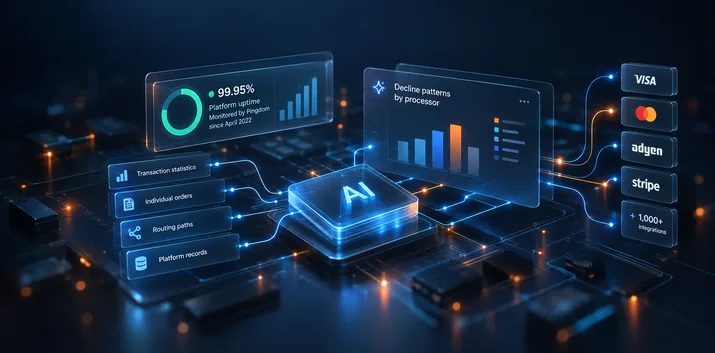
Payment gateway uptime matters most when a PSP, ISO or enterprise merchant can check the claim and understand what it covers. Payneteasy reports 99.95% platform uptime, monitored by Pingdom since April 2022, and links to a public status page. When evaluating a payment orchestration provider, buyers should also check which services are monitored, the reporting period and the availability terms in the SOP (SLA).
Uptime shows whether the platform is available. It does not explain why a payment was declined or how it travelled through a particular route. Payneteasy MCP addresses those operational questions: a team member can ask an MCP-capable AI assistant about transaction statistics, individual orders, routing paths and platform records. The assistant queries the data permitted by its access token and returns an answer based on current backoffice information. Through MCP, it cannot authorise, capture or refund payments, initiate payouts, move funds or change platform settings.
An uptime figure is most useful when a buyer can check the monitoring record and see what the figure measures. A head of payments evaluating orchestration vendors needs to know whether the number describes the gateway itself, a particular endpoint or a broader payment flow. That distinction matters when merchants will depend on the platform to process live transactions.
Payneteasy reports 99.95% platform uptime, tracked by Pingdom since April 2022, and links to the monitoring record from its Trust & Verification page. The company has operated in payments for over 20 years, giving buyers an established platform to assess rather than a new service with a short monitoring history. The published uptime figure is a record of observed availability, not a substitute for the availability commitment in a customer’s contract.
The practical question for payment teams is what an AI assistant can investigate when a transaction pattern changes. Payneteasy MCP connects an MCP-capable assistant to operational data and supported tools inside the payment platform. A team member can ask a question in plain language, and the assistant can query the permitted backoffice data to return an answer.
Be precise about what this is and isn't. MCP lets an assistant examine transaction statistics, individual orders, routing information and platform records. It does not provide the Pingdom uptime metric or execute the payment flow. Payneteasy’s payment gateway and orchestration platform handle processing and routing; the Processing API is separately documented through a machine-readable OpenAPI 3.1 specification. MCP helps a team investigate what happened within the permissions granted to it.
For a PSP or platform evaluating vendors with AI-assisted tooling, the use case is concrete: a payment operations team can compare decline patterns by processor or investigate the processing trail of an individual order without manually assembling the answer from several backoffice views.
Payneteasy’s uptime figure concerns the availability of the monitored platform service. Smart routing and cascading address a different problem: what the configured payment flow can do when a connected provider is unavailable or an eligible transaction needs another route. If an alternative provider is connected and the routing rules allow it, the platform can send the payment through that route.
This is why a single uptime number does not tell a buyer everything about payment continuity. A platform can be available while an individual processor has a problem; likewise, a fallback route cannot help if the gateway itself is unavailable. Payneteasy offers more than 1,000 pre-built payment integrations, covering providers, methods and other payment connections. That figure does not mean a customer has 1,000 active PSP routes: buyers need to check which connections are live and eligible for their merchants, markets and payment methods.
Orchestration decisions carry a time cost that rarely makes it into the uptime conversation: how long before the platform is actually processing live transactions. Payneteasy states that a branded gateway can typically launch within 1 week, depending on integration scope, configuration, testing and the required provider arrangements. Its Processing API has an OpenAPI 3.1 machine-readable specification, which gives integration teams a structured description of the API alongside the documentation.
The platform runs white-label under your own brand, which matters specifically for PSPs, ISOs and platforms whose commercial position depends on merchants seeing their name, not an infrastructure vendor’s. Payneteasy is a payment technology and orchestration platform, not a payment facilitator. Buyers should assess the gateway technology separately from the acquiring relationships and merchant-account arrangements their business requires.
| Capability | What a buyer should check | Payneteasy |
|---|---|---|
| AI access to operational data | Which transaction, order and platform records can an assistant query? How is access restricted? | MCP provides token-controlled access to supported backoffice data and tools. |
| Uptime evidence | What is monitored, over which period, and where can the record be checked? | 99.95% reported platform uptime, tracked by Pingdom since April 2022, with a public status page. |
| Integration API | Is there a documented, machine-readable specification? | Processing API described through an OpenAPI 3.1 specification. |
| Routing resilience | Which alternative routes are live and when can the platform use them? | Smart routing and cascading across configured, eligible connections; 1,000+ payment integrations available in the platform. |
| Branding | Which merchant-facing components can carry the buyer’s brand? | White-label gateway under the buyer’s brand. |
| Time to launch | What work is needed before the buyer’s own payment flow goes live? | Stated gateway launch time of typically 1 week, depending on project scope. |
The distinction for buyers is between evidence they can check publicly and operational information their authorised team can investigate after connecting to the platform. Pingdom provides the published availability record. Payneteasy MCP gives an assistant access to permitted payment operations data. Neither should be presented as a replacement for testing the buyer’s actual routes, reviewing the applicable agreement or checking how incidents are handled.
It is the percentage of time the monitored gateway service is available. It does not measure whether every payment is approved. Payneteasy reports 99.95% platform uptime, monitored by Pingdom since April 2022, and links to a public status page. Buyers should check what is monitored and how availability is defined in their applicable agreement.
Payneteasy MCP connects an MCP-capable assistant to permitted operational data in the Payneteasy backoffice. It can help investigate transaction statistics, individual orders, routing paths and platform records. Access is controlled by a restricted token. The assistant receives no raw PAN or CVV and cannot authorise, capture or refund payments, initiate payouts, move funds or change platform settings.
Payneteasy provides payment gateway and orchestration technology; it is not a payment facilitator. PSPs, ISOs and platforms should assess their acquiring relationships and merchant-account requirements separately from the technology they use to route and manage payments.
If a connected provider is unavailable or a transaction qualifies for another attempt, the platform can use a configured, eligible alternative route. Payneteasy offers more than 1,000 payment integrations, but that does not mean every customer has access to 1,000 active PSP routes. Routing can help manage provider-level disruption; it does not change the gateway’s own uptime figure.
Payneteasy states that a branded gateway can typically launch within 1 week. The actual timeline depends on the project’s integration, configuration, testing and provider arrangements. The Processing API has a machine-readable OpenAPI 3.1 specification, and the white-label gateway can operate under the buyer’s brand.
Thank you for reaching us. Your request has been sent successfully. We will get back to you as soon as possible.
Message was not sent