


Payneteasy OpenAPI: Generate API Clients in Minutes
Payneteasy OpenAPI specification makes connecting to our gateway simple and gives full control of the gateway’s functionality through API rules and AI agents.
26.06.2026
4 min read
Meet us at conferences around the world

SiGMA Europe
Payneteasy OpenAPI specification makes connecting to our gateway simple and gives full control of the gateway’s functionality through API rules and AI agents.
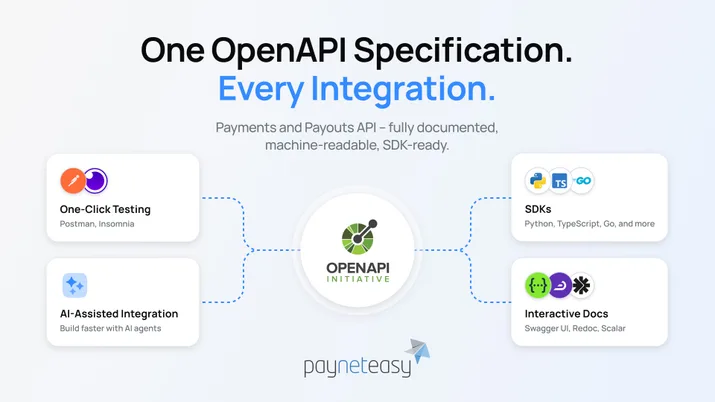
OpenAPI is an industry-standard way to describe an API in a single, structured file — every endpoint, every input, every data type. It’s a blueprint that software can read and act on directly, not just a manual a person has to interpret.
Payment service providers, banks, fintechs, merchants and their developers put real effort into integrating new merchants into their systems. Even with thorough documentation, a developer still has to work through field formats, enum values, and error semantics before the first request succeeds — manual work around the API contract that a machine-readable specification can reduce.
Payneteasy addresses that bottleneck with a complete OpenAPI specification for its long-standing Payneteasy Processing API. This specification makes a single machine-readable file authoritative. Payments and payouts are described in one specification that integrators can read, validate against, and generate code from on day one.
From prose-only documentation to prose plus a machine-readable API contract.
| Prose documentation | Plus a machine-readable contract |
|---|---|
| Detailed prose documentation, written for a person to read | A structured OpenAPI 3.1 specification covering the entire API |
| API responses in a single format (form-urlencoded) | Responses can also be returned as JSON, which is easier for many tools to deserialize and validate automatically |
| Detailed prose, without a machine-readable contract file | One published file that code generators and AI tools can all read automatically |
| Client code written by hand against the prose docs | Typed clients and models can be generated in minutes, reducing manual coding around the API contract |
| SDKs and Postman/Insomnia collections assembled manually | Auto-generated SDKs (Java, Python, Go, TypeScript and other languages supported by OpenAPI Generator) and one-click Postman/Insomnia import |
| Endpoints explored by reading the documentation | Interactive docs you can browse and send live test requests from — no setup |
| No machine-readable contract for SDK generators or AI tools | AI coding assistants (Claude Code, Cursor) read the spec and scaffold a working client |
Three steps, with less manual coding around client setup and request/response models.
It’s a single, structured “blueprint” of our entire payment API — written in a format that both people and software can read automatically.
The same standards-based contract is what makes the API ready for AI-assisted integration. Because the specification is machine-readable, a developer can hand the spec URL to an AI coding agent such as Claude Code and ask it to integrate Payneteasy; the agent reads the contract and generates a working client — with models, tests, and examples — directly in the team’s own codebase, in their stack and conventions, in minutes. For analysts scoring developer experience, that is a concrete, standards-driven capability rather than a proprietary add-on.
Because the contract is OpenAPI 3.1, let your tools do the typing: generate client SDKs in your language, import it into Postman or Insomnia, or feed it to an AI coding assistant to scaffold the API integration. For the full reference and step-by-step integration guides, see the Payneteasy OpenAPI documentation.
Thank you for reaching us. Your request has been sent successfully. We will get back to you as soon as possible.
Message was not sent