Contact us
About us
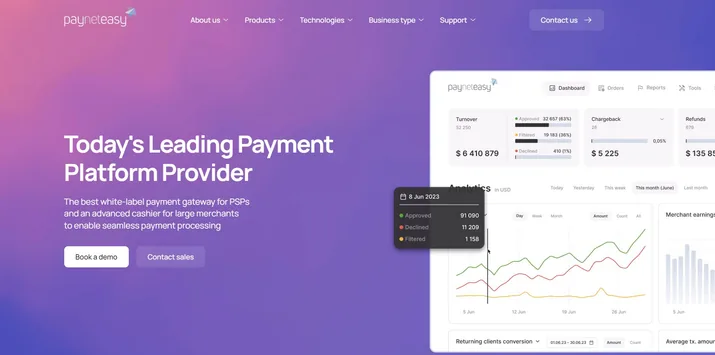
Payneteasy is a leading payment platform provider. Our state-of-the-art technologies and multiple layers of flexibility boost the fastest and most efficient integration and customization.
Technologies
Payneteasy wants to make sure that every legit transaction through the gateway turns into profit. It takes an array of features to make that happen, and by white labeling the Payneteasy solution, you have immediate access to them all!

Explore payment technologies

Business type
Our clients have advantage with the full-fledged FinTech tools. Payneteasy offers technological processing solutions for different payment industry players and large-scale online businesses.
Events

Meet us at conferences around the world

SBC Summit Malta

SBC Summit Malta

29-30 April, 2026 St. Julian's, Malta
iGB L!VE London

iGB L!VE London

1-2 July, 2026 London, UK
SBC Summit Lisbon

SBC Summit Lisbon

29 Sep-1 Oct, 2026 Lisbon, Portugal
SiGMA Europe

SiGMA Europe

2–5 Nov, 2026 Rome, Italy
View all Upcoming Events

Blog

Recent blog posts

Global

Invisible Payments: The Future of Seamless Transactions

As payment providers continue to innovate, the goal for businesses is clear — streamline transactions and remove any barriers that slow the process down. The result is faster, simpler payments that save time and effort, which leads to more transactions and greater efficiency. The shift is already taking shape with consumer-facing digital platforms and apps that create smoother shopping experiences. However, when it comes to other types of transactions, the road ahead is less clear.

10 min
Global

ISO 20022: Redefining Standards in Global Payment Systems

The global shift to a standard format for card and mobile payments has improved the user experience worldwide as digital payments continue to grow. There have been some advances in cash management, but the real change will come with the global use of ISO20022 across the SWIFT (Society for Worldwide Interbank Financial Telecommunications) network. This will be instrumental for further digital progress in international and high-value domestic payment systems.

5 min
Global

Payments as a Strategic Asset in the EU

Viewing payment processing as simply an expense overlooks a big opportunity. Leaders should recognise that payments are more than just a necessary function; they can be a powerful way to drive profit. With the latest advancements in payment technology, businesses can reduce costs while creating new sources of revenue.

10 min
Global

UAE: Current Payment Environment and Future Trends

Located at the intersection of East and West, the Middle East and Gulf regions have strong connections with both emerging and established economies. This unique position has allowed them to adopt various global best practices and made the region an exciting place for payment system innovation.

10 min
Global

Brexit’s Ripple Effect: What It Means for European Payment Gateways

On 31 January 2020, the UK made history by pulling out of the European Union. Commonly known as Brexit, a portmanteau of ‘British exit’, this withdrawal was a controversial one, with the Leave faction only winning by a margin of 3.78%. Indeed, so split was the UK in the wake of the Brexit referendum that today, nearly five years later, it is still an area of contention for many throughout the country.

4 min
Global

UK: 2024 Analysis of Payments and eCommerce Trends

The UK payments landscape has changed dramatically over the last decade and has provided consumers with more choices and flexibility than ever. People can now select the payment method that suits them best, and the systems behind these payments deliver real value to both consumers and businesses.

11 min
Global

Global Payment Systems and Geopolitics

International trade and finance are both hugely important forces in our increasingly interconnected world, both driven by cross-border payments. Cross-border payments — that is, transactions that take place between two or more countries — form the backbone of today’s global economy, facilitating the exchange of goods, services, and capital internationally.

11 min
Global

The Metaverse’s Impact on Payments

The metaverse is an immense virtual space populated by various immersive, 3D worlds where users can interact through the use of avatars; the very concept seems to have been taken straight out of a work of science fiction! This is fitting, seeing as the term was itself coined by writer Neal Stephenson in his sci-fi novel Snow Crash.

12 min
Global

Collaborative Regulation: How FinTech Companies Can Work with Regulators for Mutual Success

Despite FinTech having been around for quite some time in one form or another, this technology has proven challenging for regulators to keep on top of. This is not altogether surprising when one considers the incredible rate at which the industry has grown over the last few years; new businesses, new products, and new risks turn up all the time and will likely continue to do so.

5 min
Global

Sustainable Payment Solutions: 2025 Trends

As the impact of climate change becomes more and more pronounced, finding sustainable payment solutions for the future has become a marked point of interest in the financial sector. In fact, Environmental, Social, and Governance (ESG) factors have been driving forces behind technological development in recent times. The role of ESG in payments is important, as an ever-greater number of consumers are seeking out low-impact, environment-friendly payment options.

11 min
Global

Cross-Border Payments in 2024: Navigating the Complexities of Global Transactions

In our increasingly globalised world, cross-border payments — transactions where the sender and the recipient are based in different countries — have become more and more important. Indeed, cross-border payments are essential to the world’s economy, having made it quicker and easier than ever before to move funds between countries.

5 min
Global

How FinTech Is Reshaping the Financial Landscape in Developing Economies

According to the International Monetary Fund (IMF), 152 nations around the globe can be classified as developing countries. With a collective population of almost 6.9 billion, this means that less than 12% of the global population exists within a developed economy. In other words, there is still plenty of room for improvement.

5 min
Shown 25-36 articles from 290