 By Daniel Karpilovsky, Head of Success, Payneteasy
Two ideas run through this article. Payment orchestration is the practice of connecting a business to several banks and deciding, per transaction, where each payment goes and where it retries after a decline. MCP, the Model Context Protocol, is an open standard that lets AI assistants connect to external tools and data sources; the Payneteasy MCP server gives an assistant read-only access to your payment data, so it can explain what happened but cannot change anything. Orchestration recovers declined payments; MCP makes the results easy to understand.
If you accept card payments, you are almost certainly losing some of them right now — not to fraud, but to harmless technical declines you never even see. The good news: the fix no longer takes an engineering team. Here is what payment orchestration actually does about it, what the “AI agents” everyone is talking about can genuinely do today — and, just as important, what they cannot — in plain English.
The short version: an orchestration layer connected to many banks quietly recovers sales a single-bank setup loses — and an AI assistant can now read and explain that layer for you, safely, without ever touching the money. If you want both working for your business, talk to our team or see the orchestration platform.
What this is about, in one minute
Two technologies, one story. The first is the routing engine — at Payneteasy it is called Smart Payment Strategy. It sends every card payment to the acquiring bank most likely to approve it, based on card type, geography, amount and accumulated processing statistics, and when an acquirer declines, it automatically retries the payment down a configured chain of alternatives. It is deterministic platform machinery — rules and statistics your team controls, not an AI improvising with your money.
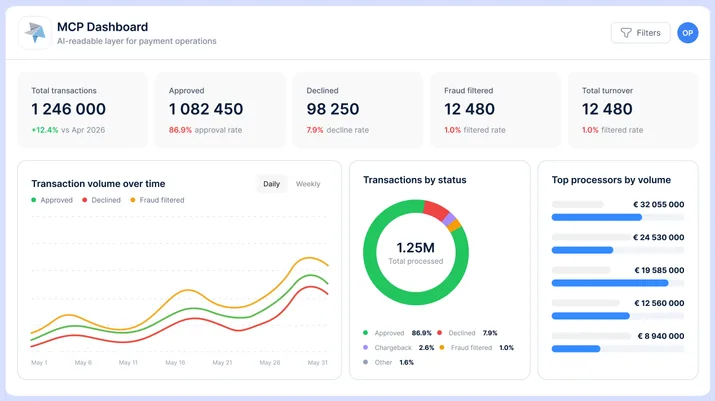
The second is MCP Agent Access — a separate, read-only layer that lets an AI assistant (Claude, ChatGPT, Gemini — the chatbots and agents built on Generative AI, or GenAI) see what is happening inside that platform and answer questions about it in plain language. It reads and reports. For security reasons, it cannot authorise, capture, refund, move money, or change routing rules.
The payoff: the engine recovers sales you’ve already won — payments that would die on a single bank’s “no” get another chance and clear. The assistant recovers your time — the hours spent digging through dashboards to understand what happened become one plain-language question and one clean answer.
What the orchestration layer actually does
The routing system combines different types of traffic and sends each transaction to the processor best suited for it, based on criteria such as country, card type and transaction amount. The balancing system accumulates processing statistics to work out which acquirer performs best for each client and traffic type — there is even a machine-learning balancing option, and a mode that reorders the chain per returning customer based on their payment history. All of it is configured by your team and runs inside the platform.
When a payment is declined, cascading takes over: the transaction is automatically rerouted through a chain of alternative acquirers, in real time, without the customer noticing — until it gets approved or the chain is exhausted. Many declines are not real refusals: a timeout, a cautious fraud rule, a momentary glitch. Trying a different acquirer clears a meaningful share of them, and that is where the recovered revenue comes from.
Why many banks beat a single bank
Most payment integrations work like a cashier who only knows one bank: when that bank says “no”, the sale is gone, full stop. Orchestration puts a floor manager in charge instead — one who knows every bank you work with and sends each payment to whichever one is most likely to say “yes”. That floor manager is the routing engine, working from your rules and its own accumulated statistics, and it never gets tired or forgets a bank exists.
It also doesn’t go stale, which a single hard-coded route always does. A one-bank setup reflects whatever someone expected the day it was integrated and then sits there. A balancing system that keeps score on live traffic notices the moment a different acquirer starts converting better for a given card type or region and shifts weight toward it — per merchant and per geography, with an option to reorder the chain for each returning customer. Nothing magic about it: the decision just runs on current data across many banks instead of freezing on the one connection you happened to set up first.
One-bank vs orchestration, side by side
For a clearer comparison, the key differences are summarized in the table below.
| Single bank / single route | Multi-bank orchestration |
|---|
| Banks it can reach | Just one | Many, through a single connection |
| When a payment is declined | Gives up; the sale is lost | Cascades it through a chain of alternative acquirers |
| How it chooses an acquirer | Always the same one | The route your rules and balancing statistics rate most likely to approve |
| How it adapts | A human re-integrates, eventually | Balancing accumulates live statistics; chains are reordered, even per returning customer |
| If a bank has an outage | Payments stop | Traffic shifts to a working acquirer in real time |
| What an AI assistant can see | One bank's own reporting | The whole layer, read-only, through MCP — in plain language |
The numbers — and where they come from
Honest answer up front: published recovery percentages — ours included — are industry aggregates from mixed portfolios, not a verified figure for your business. We are not going to hand you someone else's benchmark and call it a promise. Treat any number you see quoted, anywhere, as a rough industry direction — your actual lift depends on how good your routing already is, your geography mix and your merchant type.
Smart initial routing improves acceptance simply by matching card type and geography to the best-fit provider up front, before a single decline happens.
Retries on declined payments recover a meaningful share of them, because a real portion of declines are not genuine refusals — they are noise from conservative fraud models and technical hiccups. Cascading to a different acquirer clears a chunk of exactly that noise.
Together, both effects compound into a real, not marginal, lift in overall acceptance. If you want to see what that looks like in practice rather than take our word for it, read our own cascade recovery data — and ask any vendor you are evaluating for the same. Out of every hundred sales you were about to lose, some come back — sales you already earned.
What this means for your business
You lose fewer sales. Payments that used to fail and walk away get a second chance at a different bank. Recovered sales are the cheapest revenue there is — you already did the work to earn them.
You spend less time on payment headaches. Working out which bank settled what, chasing failed renewals, checking why approvals dipped — these are exactly the questions an assistant can answer from the platform’s read-only data and hand you one clean answer instead of five messy ones.
You are not trapped with a single bank. If a bank raises fees, has an outage, or simply performs worse for your customers, payments go elsewhere. You stay in control, and your customers keep paying.
Where MCP fits: a read-only window for AI assistants
An “AI agent” needs a way to plug into your systems. The technology world agreed on a standard plug for exactly this — the Model Context Protocol (MCP). Think of it as a USB port: one agreed socket any AI assistant can connect to. Payneteasy fits this socket in two ways.
1. AI-assisted integration
Our Processing API is built to be read by AI. Payneteasy's own documentation invites you to feed the API specification to an AI coding assistant to generate clients and integrations — the work that used to take weeks of engineering becomes a conversation.
2. A read-only MCP over the platform's data
Our MCP server exposes the read side of the platform to an AI assistant through one secure, scoped connection: transaction statistics, order lookup, and platform reference records — merchants, projects, endpoints, gates and processors. Instead of clicking through screens, you ask in plain language — “why did approvals dip yesterday”, “what were this merchant’s top decline reasons last month”, “find the failed order for this invoice and explain what happened” — and the assistant picks the right tool and answers.
Let me be precise about the boundary, because it is the part I am proudest of: this is not a payment automation tool, it does not replace the gateway, and it does not move money. The assistant can read and report. It cannot authorise, capture, refund, or change platform settings — there is no tool on the socket that could.
Who decides, who explains — the honest division of labour
So here is the division of labour, stated plainly. The platform decides. Routing, balancing and cascading are done by Smart Payment Strategy — deterministic machinery driven by your rules and the platform’s accumulated statistics, running long before any AI assistant is in the room. The assistant explains. Connected through MCP, it reads the outcomes of those decisions — which route a payment took, where it stopped, how approval rates are trending — and turns them into answers and recommendations. It never chooses a route, never triggers a retry, never edits a rule.
Why is read-only the right design rather than a limitation? Because in payments, an assistant that can be talked into moving money is a liability, not a feature. The recovery happens in the orchestration layer; the assistant makes that layer legible. And this is why the two belong together: point an assistant at a single bank and it can only ever tell you one bank’s story. Point it, read-only, at a layer that spans many banks, and every answer covers your whole payment operation — including the sales the cascade just recovered.
Where Payneteasy fits
Payneteasy has spent more than 20 years being that floor manager: Smart Payment Strategy routes payments across many banks and cascades the ones that fail, inside the orchestration platform. MCP Agent Access — the modern “socket” — connects AI assistants to that layer, safely and read-only.
One more thing worth saying plainly: a payment company tied to its own bank has every reason to keep your traffic there even when another bank would serve you better. An independent platform doesn’t — it sends each payment wherever it actually clears best, because that is what keeps you happy. Choosing who handles your payments is really choosing whose interest the routing serves. If you are starting to think about what software gets to see and decide in your business, start with the layer it will look at — and pick the one whose interest is your approval rate, not its own lock-in.
* Source: modelcontextprotocol.io, the Model Context Protocol specification site.
Merchants
Only one integration to consolidate all your payment providers to a unified management system.