


How to Choose a White-Label Payment Gateway Provider
Compare white-label payment gateway providers on branding, acquiring integrations, PCI DSS responsibilities, routing, total cost, support and migration terms.
03.07.2026
12 min read
Meet us at conferences around the world

SiGMA Europe
Compare white-label payment gateway providers on branding, acquiring integrations, PCI DSS responsibilities, routing, total cost, support and migration terms.
A white-label payment gateway provider supplies the technology that lets a PSP, bank or fintech offer payment services under its own brand. Choosing one means evaluating more than a branded checkout: you need to understand which integrations are available, who controls routing, how operational responsibilities are divided and what happens if you later change suppliers.
This guide explains what to verify before signing a contract, which questions to ask during a demo and how to compare the full cost of operating a white-label gateway.
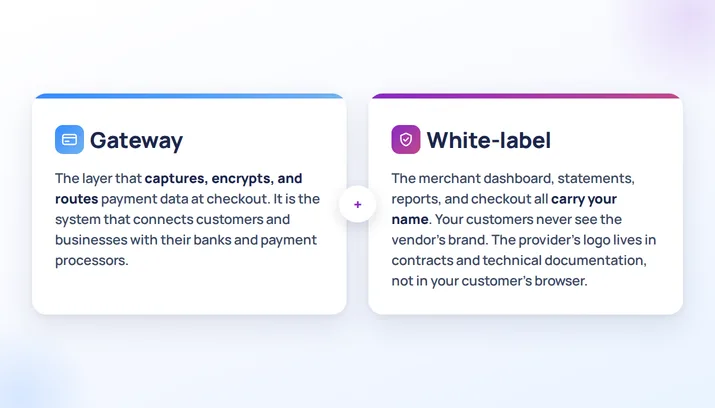
Let me define two words up front. A "gateway" is the layer that captures, encrypts, and routes payment data at checkout. "White-label" means the dashboard your merchants log into, the statements they read, and the checkout they integrate all carry your name. The vendor's name appears nowhere your customers can see.
That distinction sounds cosmetic. It is not. It is the difference between reselling someone else's product on their roadmap and running an asset that renews with you. Keep that frame as you read on. Every criterion below either protects that ownership or quietly hands it back to the vendor.
Payneteasy's model is genuinely white-label:
This directly addresses the first pain many ISOs, PSPs and platforms feel with other providers: they invest in sales and support, only to see the vendor's name take the loyalty and referrals. With Payneteasy, that asset accrues to you.
Ask each shortlisted provider the same questions and request evidence for the answers. A demo should show how the platform handles your payment flows, including the integrations, operational controls and reporting your team needs.
| Criterion | What to Verify |
|---|---|
| Branding | Which checkout pages, portals, domains and notifications can carry your brand? What requires additional development? |
| Acquiring Integrations | Are your required acquirers and payment methods supported for the countries, currencies and transaction types you need? |
| Routing and Cascading | Can you configure routing rules, inspect processing attempts and restrict retries by response code and provider requirements? |
| PCI DSS Responsibilities | Can the provider supply a current Attestation of Compliance covering the relevant services and explain your remaining responsibilities? |
| Merchant Management | Can your team manage merchant access, projects, permissions and transaction limits in the way your operating model requires? |
| Reporting and Reconciliation | Can you export transaction and fee data and match it against acquirer settlement reports? Which tasks require manual work? |
| Reliability and Support | What does the SLA cover? How are incidents escalated, and what support is available outside business hours? |
| Implementation | Which integrations, approvals, configuration tasks and tests must be completed before the first live transaction? |
| Total Cost | What are the setup, recurring, usage, integration, customisation and support charges? Are there minimum commitments? |
| Migration and Exit | Can you export operational data? What restrictions apply to tokens, custom developments and termination? |
| AI Access, If Required | Which data can an assistant access, how are permissions controlled and can its credentials trigger payment actions? |
Branding sits on top of the part that actually makes money. That part is routing. In a modern payment stack:
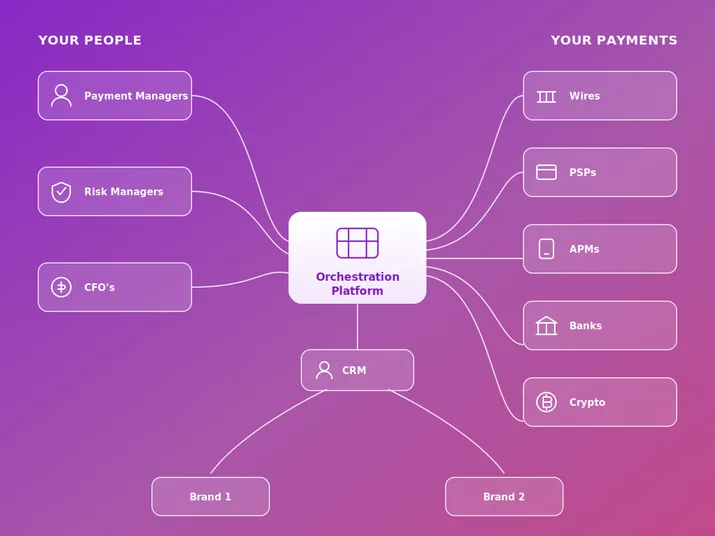
On top of an OpenAPI-described processing API, routing and cascading give you three concrete advantages:
Payneteasy's orchestration runs on a Processing API described in OpenAPI 3.1 and gives you:
One honest caveat that also protects you: Payneteasy routes across the bank and provider relationships you already hold. It is not a PayFac or acquirer. You bring and keep your acquiring; Payneteasy's job is to make those contracts work harder through better routing. That separation addresses the fear many PSPs and ISOs have that a "platform" will quietly become their competitor.
If your team plans to use AI assistants for payment analysis, check the available data interfaces, access controls and permitted actions. Ask which records an assistant can query and how its access can be restricted or revoked.
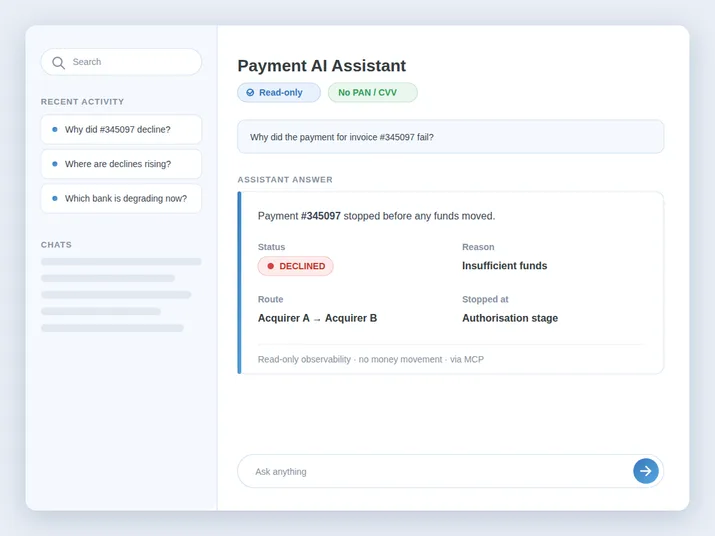
Payneteasy MCP provides scoped, revocable access to transaction statistics, individual orders and platform reference data. An assistant cannot authorise, capture, refund, move funds or change platform settings through MCP. The interface does not return raw PAN or CVV.
This can support operational investigation and reporting. Assess the security and PCI DSS implications of the complete implementation, including the connected assistant.
Payneteasy's MCP layer adds AI-powered payment observability to the white-label gateway, allowing teams to investigate payment operations through scoped access without granting payment execution capabilities.
Score every provider against criteria that map to revenue and risk, not a feature grid. Run down this list on your next call.
The row most competitors cannot credibly fill is the AI-agent one paired with a hard architectural boundary around money movement. If a provider cannot show you that line on an architecture diagram, not just in a brochure, it does not exist.
| Criterion | What to ask |
|---|---|
| Brand ownership | Is it truly your gateway, or their product with your logo on it? Do merchants ever see the vendor's name in the dashboard, checkout domain, emails or statements? |
| Time to live | Are you looking at weeks of configuration or at a multi-quarter engineering project? How many weeks of unbilled revenue are hidden inside the implementation plan? |
| Routing control | Can you author and maintain your own routing and cascading rules across multiple providers and banks? Or are you locked into vendor defaults and opaque decision trees? |
| AI-agent access | Can AI assistants access operational data through a scoped, revocable interface that does not permit payment actions? Or is "AI access" possible only via credentials that could also move money? |
| Money-movement boundary | Is the separation between read access and write/settlement enforced in the architecture? Or is it simply promised in a contract and left to best effort? |
| Track record | How long has the platform processed real volume under real load and regulatory scrutiny? Is there evidence of surviving high-stress scenarios before yours? |
Compare the total cost of operating the gateway at your expected transaction volume. Ask providers to separate implementation charges from recurring platform fees and identify any usage charges, minimum commitments or optional modules.
Include the cost of new integrations, customisation, additional environments, support and future changes. Confirm whether acquiring and payment-method fees are included in the proposal or charged separately by your payment partners.
Request quotes against the same scope and volume assumptions. A lower platform fee may be offset by integration charges, contractual minimums or the work your team must perform internally.
Review the SLA alongside the product demo. Confirm how availability is measured, which exclusions apply, how planned maintenance is handled and what incident response commitments the provider makes. Historical uptime and a contractual availability commitment are different forms of evidence.
Before signing, establish how you can retrieve transaction records, reports and configuration data. Token portability requires a separate discussion: it depends on the token type, vault arrangements and the receiving provider’s capabilities.
Ask who owns custom developments, what termination notice is required and what migration assistance is available. These terms affect the cost and difficulty of changing providers later.
If payment routing infrastructure is your product and you have the engineers and years to invest, building your own engine can make sense. You will own every line of code and every operational risk.
For most PSPs, platforms and large merchants, the trade-off looks different:
Building means multi-quarter timelines, high opportunity cost, and the responsibility to maintain a complex engine for a decade.
Buying Payneteasy means trading that engineering effort for:
A white-label model can preserve your brand and merchant relationships while the provider supplies the gateway technology. Confirm software licensing, customisation rights, data access and exit terms in the contract.
A white-label payment gateway provider supplies the gateway technology you operate under your own brand, so your merchants see your name across checkout, dashboards, and statements. The strongest providers also give you control over routing and integration rather than a fixed product. Payneteasy lets you launch a branded gateway typically within 1 week.
It means assistants like ChatGPT, Claude, or Copilot can read your live payment data through a safe, structured interface. Payneteasy provides this with a read-only MCP server: agents observe payments and routing state and can never move money. Teams get AI for analysis and reconciliation without widening their PCI or fraud exposure.
No. The MCP server is read-only observability by design, so agents can read payment and routing data but cannot start, change, or move a payment. Money movement runs through a separate Processing API governed by your own systems and rules. That separation is the security guarantee, not a setting you have to switch on.
Payneteasy launches a white-label payment gateway typically within 1 week under your own brand. The speed comes from running on an established platform instead of building processing infrastructure yourself, so your go-to-market is measured in weeks of configuration, not quarters of engineering.
Yes. Payneteasy works with the acquiring banks, PSPs and payment providers you already use. It operates as the technology and routing layer rather than replacing your commercial relationships or taking over settlement.
Licensing gateway technology does not itself provide FCA authorisation. If your company provides regulated payment services in the UK, it may need to be authorised or registered unless an exemption applies or it is already appropriately regulated.
No. A PCI DSS Level 1 provider can reduce the amount of card data handled by your systems, but your own PCI DSS scope depends on the integration method and the wider payment environment.
Thank you for reaching us. Your request has been sent successfully. We will get back to you as soon as possible.
Message was not sent